Susuro

Deliverance And Spiritual Warfare by Holy Tongue

The curators and initial line-up for Le Guess Who were announced a few weeks ago…time to do some homework. Valentina Magaletti looks to be the Zelig of the 2023 edition — I count at least three of her projects on the bill (Holy Tongue, Moin, and a duo with Marta Salogni).

I already had my eye on the Holy Tongue album after a glowing write-up from Phil Freeman (Burning Ambulance, the Wire). As he says, you could slip most of the album into a post-punk dub DJ set without anyone blinking an eye, but more than Public Image Ltd. or African Head Charge, “Susuro” reminds me of Can circa Ege Bamyasi, or prime Mouse on Mars. A shoe-in if Kevin Martin ever resurrects the Macro Dub Infection compilation series!

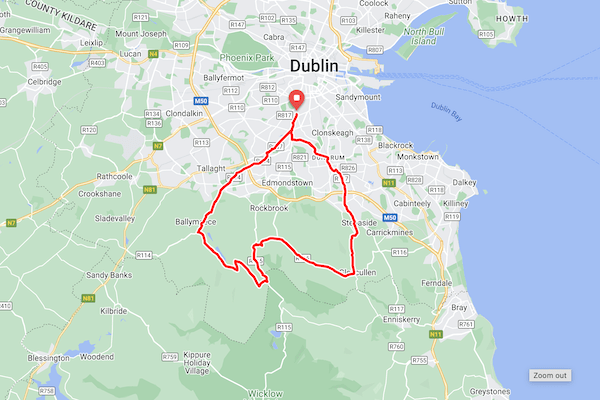
Bohernabreena Reservoir (45km, 695m)

Map of Bohernabreena Reservoir route

RideWithGPS

Categorised Climbs: Ballinascorney (First Section), Cunard Road Lower, Cunard Road Upper

Variation upon variation — this is a third way to skin the Piperstown/Glenasmole cat. It’s the most scenic option of the three, but also the hardest, featuring the short but salutary climb up Cunard Road Lower along with the demanding final kilometre of Cunard Road Upper. It would be hard to find a route that packs so much into a couple of hours so close to the city centre.

Head out of the city through Old Bawn and past the entrance to Bohernabreena reservoir to start the climb up to Ballinascorney. Take the left turn after the Footee course, as the road widens and curves right. The road above the reservoir is a joy: quiet, well-paved, tree-lined, with occasional glimpses of the water below. Follow the road around the back of the reservoir to a T-junction: left here, then the next right to take on the 15% ramp of Cunard Road Lower. Right at the top to join Cunard Road Upper — you’ll have a few moments to catch your breath before the grind up to the Featherbeds. Turn left at the T with Military Road, then the usual drop down by the Viewing Point and Cruagh Road to Tibradden, and along Pine Forest Road to Glencullen.

The only likely hazard (aside from knee trouble) is the descent down the back of the reservoir. The road itself is fine, but it’s winding and very narrow with no visibility around the corners — it’s very easy to round a corner at speed to meet a Land Rover coming the other way, with no scope for evasive manoeuvres. Don’t ask me how I know this.

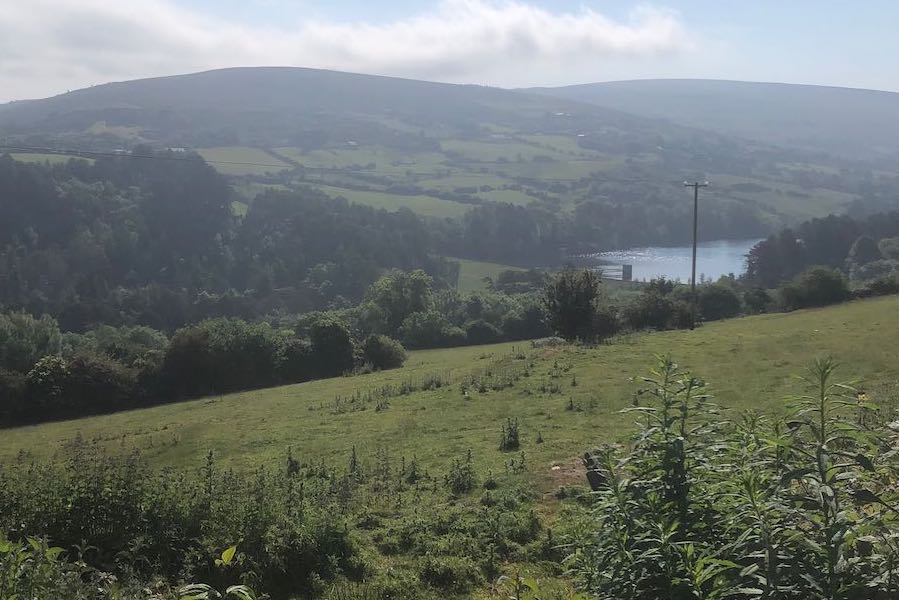
Pasture leading down to the Upper Lake of Bohernabreena Reservoir, mountains in the background
The Upper Lake of Bohernabreena Reservoir, glittering in the sunshine

Lotta Continua

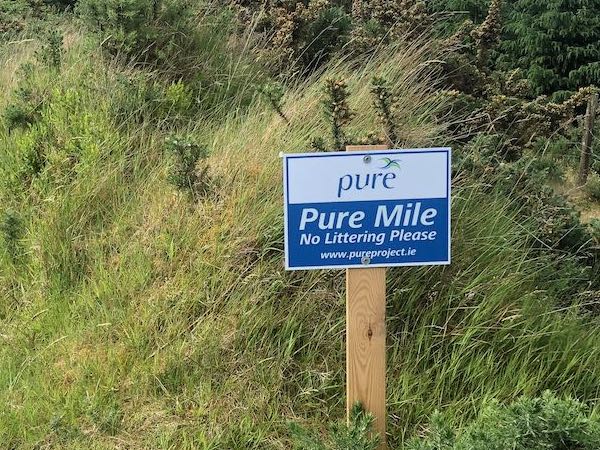
Rectangular white and blue sign reading Pure Mile No Littering Please on a post at the roadside

I must have cycled past PURE Mile signs hundreds of times before I finally checked to see what they were, who was behind them. PURE (Protecting Uplands and Rural Environments) works to reduce littering and illegal dumping in the Dublin and Wicklow mountains. There’s a welter of local government and semi-state bodies involved, but the litter-picking is mostly done by groups of volunteers. PURE provide the equipment and collect the filled rubbish sacks. The website doesn’t provide any obvious means of getting in contact with nearby groups, which seems like an omission, but after a string of emails and a couple of false starts, Celeste got us on the distribution list for the Friends of the South Dublin Uplands. Largely drawn from a hiking club, the Friends meet every month or two to clean up Military Road, Piperstown Road and Cunard Road, some of my favourite roads to cycle.

Spending an hour or two of a Sunday morning walking the verges and clambering over ditches with a litter-picker and blue rubbish sack in hand gives you pause for thought about your fellow man. I mean, we’ve all had evenings where, faced with the prospect of doing the dishes, it seemed easier to load the lot into the back of a car, drive up into the mountains, and smash the entire dinner service, plate by plate, in a lay-by. I can imagine that in the rosy post-coital glow, it seems less than urgent to retrieve your jocks from the thicket of brambles where you flung them in the throes of raw animal passion. But I struggle to fathom the purblind selfishness behind the most routine littering, the scurf of plastic bottles and coffee cups dropped from the windows of passing cars (unsurprisingly, far heavier on the side of the road outbound from Dublin). I am compiling a list of products that should henceforth be sold only under license, with stringent requirements around traceability and disposal: wet wipes, nitrous oxide canisters, and Red Bull are top of the list.

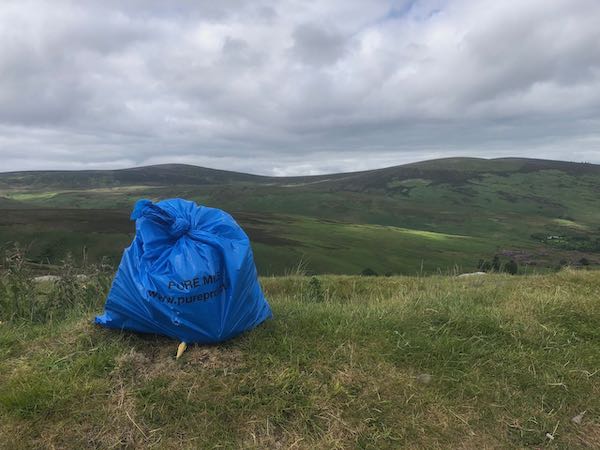
Nature engulfs some of these alien artefacts impressively quickly — you often step on what appears to be solid turf only to hear the crumple of a plastic bottle, prelude to a couple of minutes wrestling to unearth the errant container. But the rest remain an eyesore, a constant visual reminder of human thoughtlessness and waste. On the last Sunday excursion, I filled nearly three sacks with the detritus scattered along lightly-trafficked Cunard Road, all discarded in the month since the previous pick. It’s satisfying work, but Sisyphean — I’ve passed along our stretch of Military Road a couple of times since and already a fresh crop is sprouting.

Blue plastic rubbish sack with Pure branding, standing on a ditch, mountains in the background
The Blue Bag of Happiness

Trooperstown Hill (1.9km, 146m, 7.5%)

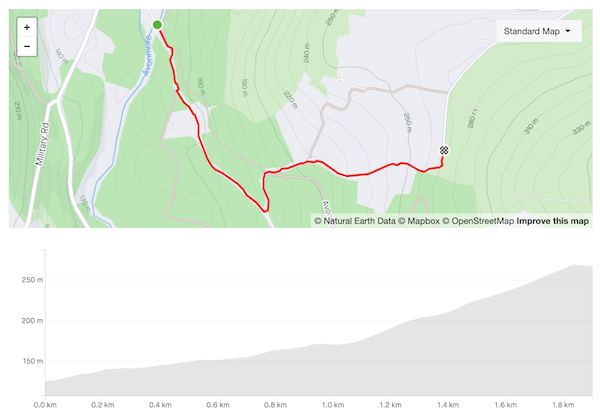
Map and elevation profile of Trooperstown Hill climb

Strava

At the time of writing, a mere 255 riders have ridden this segment on Strava, as compared to just shy of 10,000 for Wicklow Gap, so I feel confident in describing it as a hidden gem. You can find steeper, longer climbs on the west coast (Caherdaniel, may you live in infamy!) but there aren’t many other climbs in Wicklow that compare — Devil’s Glen, perhaps.

The headline numbers for the climb undersell it considerably. The gentle rise along the first kilometre from Bookey Bridge reduces the average gradient to an innocuous-seeming 7.5%, but the 900 meters after the turn average a very respectable 11% and the final ramp hits 18%. There are moments where the road appears to flatten but recovery is not easily come by — they’re still 8–9%.

The surface is heavy and there isn’t much to look at on the way up (you’ll be too busy trying to keep your front wheel planted anyway) but the views from the shoulder of the hill and the gradual descent on the other side are delightful.

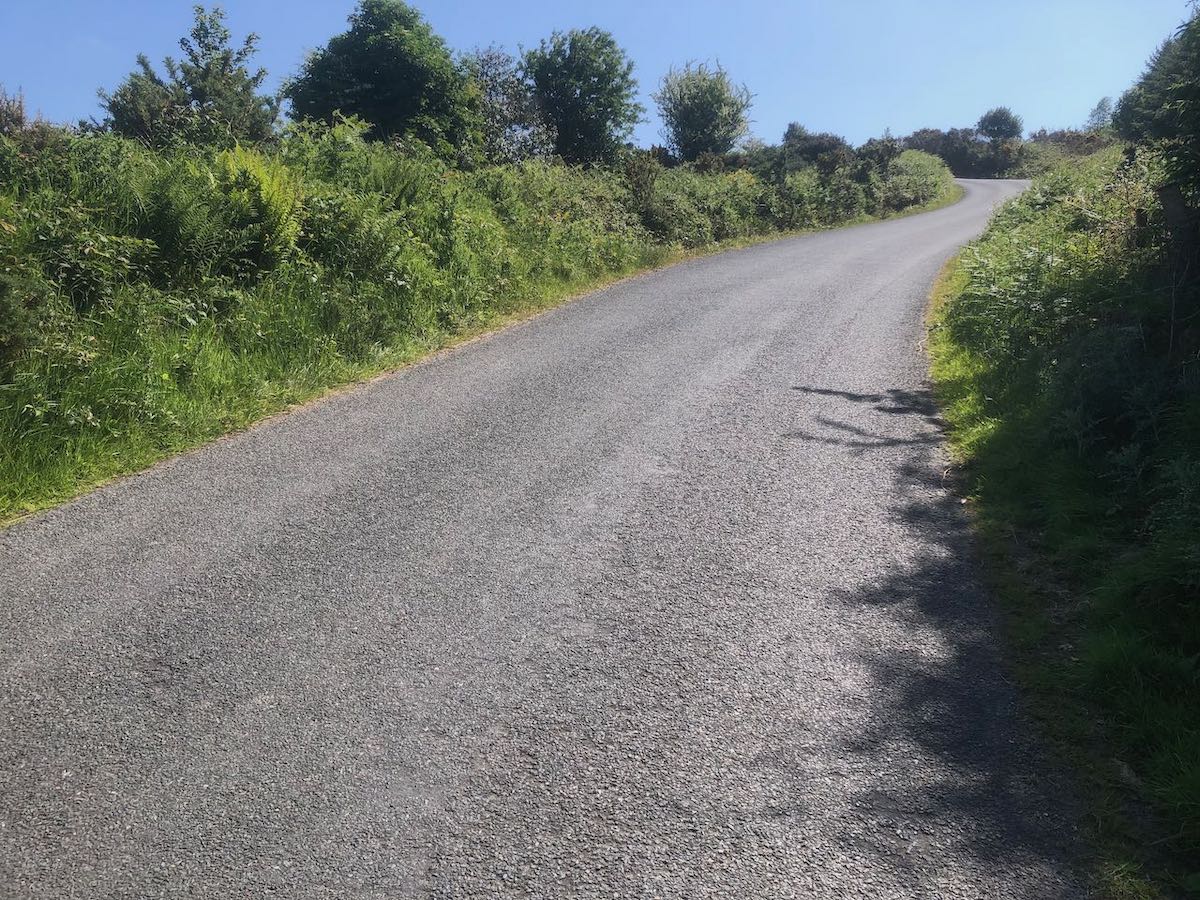
Rough country road lined with hedgerows rising steeply to a left-hand bend
The final ramp. To quote Alice Cooper, “I’m eighteen…and I like it”

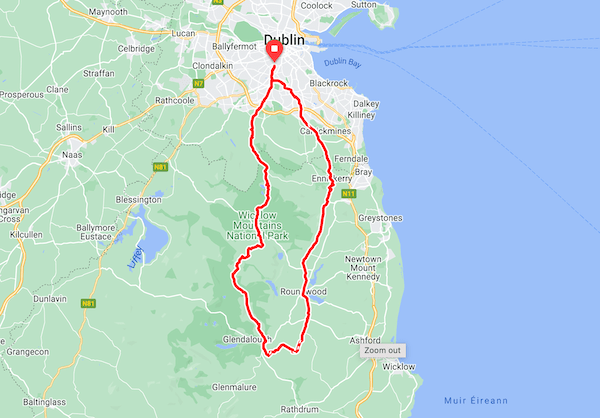
Trooperstown (93km, 1342m)

Map of Trooperstown route

RideWithGPS

Categorised Climbs: Edmondstown Road, Lough Bray, Trooperstown Hill

This route is a variation on the basic Laragh route, taking in the under-appreciated (and somewhat brutal) climb of Trooperstown Hill, so check the notes on that for the sections shared by both routes.

When you reach Laragh, go left at Lynham’s pub to take the road for Rathdrum. Take the left immediately before Bookey Bridge and climb gently for about a kilometer, then a sharp left onto the Trooperstown climb proper, which is anything but gentle. The reward comes afterwards, on the long, gradual descent around the curve of the hill — the views across the valley are lovely and you usually have the road entirely to yourself. There are a couple of tight bends and sections with loose gravel but it’s not particularly steep. At the bottom you run into the Moneystown road heading towards Roundwood. Rejoin the Laragh route just before the drag up to Ballinastoe.

The route works well in reverse too also, turning Trooperstown into a gentle, winding ascent. You’ll be riding the brakes all the way down the other side though.

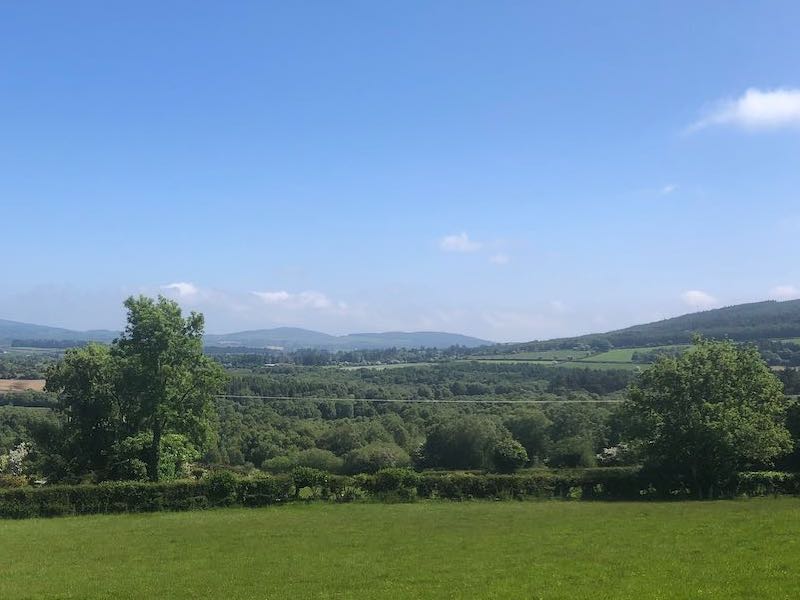
Green fields and trees with mountains in the background under an almost cloudless blue sky
Looking north-east from Trooperstown Hill

From Centre to Wave

The original incarnation of Loop endured for a scant five years at the tail end of the eighties, achieving their moment of aesthetic perfection with A Gilded Eternity and the “Arc-Lite” single, then splitting. Over the course of three albums, they pared away the extraneous, cutting out the crawling wah-wah guitar solos to leave only riffs like pulsar transmissions. No harmonic development, just drilling, distortion-drenched guitar riffs repeated over circling, tom-heavy rhythms. I can think of few other bands with the same commitment to repetition, to this kind of formal purity — Lungfish, maybe, or Wire in their terse, abrasive early days. Absent the consolations of Spacemen 3’s religiosity, A Gilded Eternity evoked a bleak, post-industrial landscape, blackened and smoke-wreathed.

After the split, Robert Hampson briefly joined Godflesh, playing on half of their third album, Pure (itself a monolithic aesthetic statement), before forming Main, with Loop’s other guitarist, Scott Dawson. Main continued the programme of reduction, quickly dispensing with drums, ultimately with guitars (and Dawson), the music so rarefied and abstracted that Main seemed to vanish into the ether, presence slipping imperceptibly into absence. It’s surprising that the last Main album appeared as late as 2013, less surprising that it appeared on Peter Rehberg’s Editions Mego label, a distance remove from rock and its mythologies. I believe Hampson spent a while leading a hand-to-mouth existence in Paris, working on electro-acoustic composition at GRM.

The return of Loop has been slow and faltering, bursts of activity separated by long periods of silence. A comprehensive reissue campaign around 2008, comprising the three albums with attendant radio sessions and demos, and the three-CD set rounding up non-album tracks. A triumphant headline set at All Tomorrow’s Parties in 2013 that recalled the thrill of the very first gigs I went to as a teenager: Sonic Youth, the Shamen, Dinosaur Jr., My Bloody Valentine, Fugazi…Loop. That all signals jammed feeling, complete sensory overload: the thick fog of dry ice and staccato glare of strobe lights, the brain-capsizing volume and distortion, the suffocating crush of bodies yearning to be closer to the stage. A new EP in 2015, Array 1, notionally the first of a trilogy that was never completed, derailed perhaps by the collapse of the ATP organisation. Scattered live appearances — I caught a lacklustre night at Le Poisson Rouge in New York. In 2022 a new album, Sonancy, released incongruously on Cooking Vinyl, a label linked indelibly in my mind with Michelle Shocked and the Cowboy Junkies. Momentum again halted, this time by Covid, postponing the accompanying tour.

Postponed until last Saturday, at Whelan’s. The usual apprehension about seeing a band you love, long after the fact, the fear of seeing something dismal, embarrassing, that might sour you on them forever. I’m not convinced by Sonancy, the sound too clean, too precise, too light. I’m don’t know whether Loop would welcome the comparison, but it stands in the same relation to A Gilded Eternity as Hawkwind’s late-seventies albums do to Doremi Fasol Latido. Recognisably the same band but lacking the thickness, the heft, that steely-eyed gaze into the infinite.

Sonancy by Loop

The venue was half-empty when I arrived, knots of greying men checking each other’s credentials, seeing who was at the gig in McGonagle’s in 1991. Robert invoked the thirty-two year gap since their last visit to Ireland many times throughout the evening. More subtly, the EU flag draped over his amplifier sported only twelve stars, as it did back then. They played a long set, an hour and forty-five minutes — this tour the last run for the older material, he warned. And it was terrific, not a moment too long. The rhythm section (Wayne Maskell and Hugo Morgan from the Heads) were locked in, the guitars were shearing and relentless. Two incredible songs where Robert sculpted feedback into something of unearthly beauty. The new songs sounded more powerful live, the slow-burn set-closer “Aurora” a particular highlight. Against all my expectations, Loop are back. Don’t miss them.

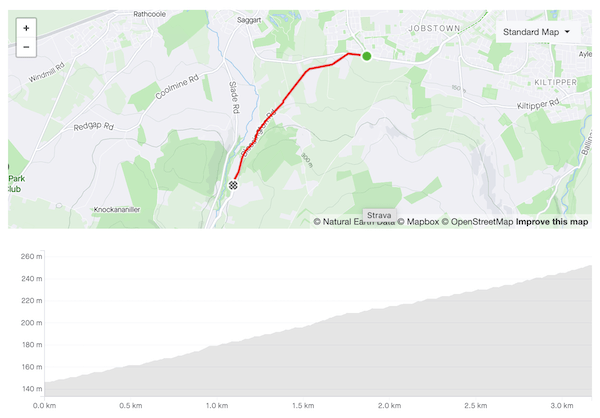
The Embankment (3.2km, 106m, 3.3%)

Map and Elevation Profile of the Embankment climb

Strava

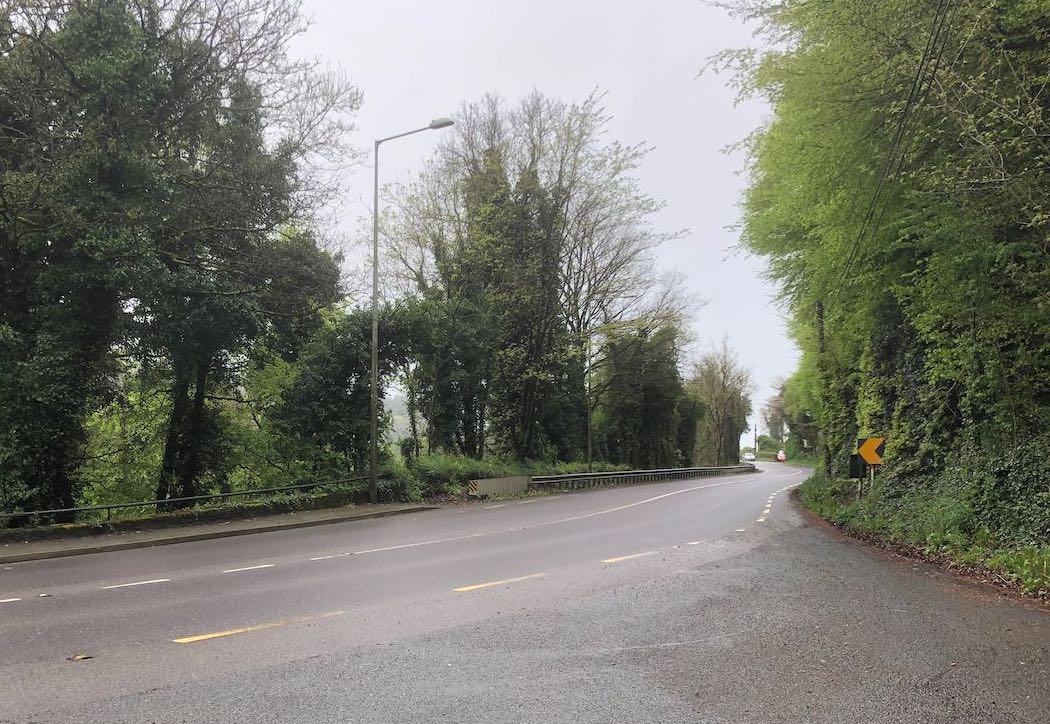
The Embankment only barely qualifies as a categorised climb, requiring judicious choice of start and end points to make the grade. It’s a rather featureless climb, three kilometers at a very steady 3–4% gradient along the N81. Despite being an N-road, the N81 is fairly narrow, with little in the way of hard shoulder to hide in as the HGVs thunder past. There’s nothing much in the way of scenery.

So why mention it? Because it has the cardinal virtue of being the only easy route out of the city towards Blessington — the fallback option when you can’t face another grind up Ballinascorney or Mount Seskin. Buckled after a hard ride yesterday? Crippled with a hangover? Recovering from yet another dose of Covid? The Embankment is your friend. During the winter when other roads are slick with frost, the N81 sees enough traffic to melt it off. The surface is uniformly good, with barely a pothole in sight. It’s sheltered from the prevailing westerly winds.

And, of course, it’s perfect for riding fixed gear — if you have any legs at all, you can storm up it in a single out-of-the-saddle effort, humming “The Ride of the Valkyries” to yourself as you go. I’ve crawled up Seskin on fixed and it’s not an experience I’d care to repeat. I can’t imagine making it over Ballinascorney on a single cog. But the Embankment gives easy access to the gentler roads of west Wicklow, and after a couple of bleak months riding around Kildare and north county Dublin, you’ll be very glad it’s there.

Wet road between tree-lined verges under slate grey sky
The top of the Embankment…as you can see, it’s all charm

Can’t Buy a Thrill (1972)

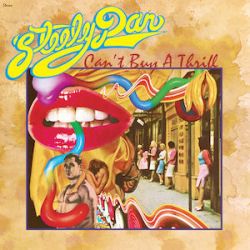
Cover of Steely Dan album, Can't Buy a Thrill. Indescribably ugly.A couple of my colleagues in Frank’s Apa (the music APA that refused to die) are working their way through the spans of their lives, picking an album to write about from each year since their birth. I thought I’d join them, but rather than make it an exercise in autobiography, relating the music to the events of my own life, I’m picking albums and and artists that I’ve never properly listened to: the overlooked, the casually dismissed, the records I’ve been meaning to get around to. Pulling together a list of candidates for the first few years of my life has been ridiculously easy, the seventies a seemingly inexhaustible seam

To start with, 1972: the year of decimalisation, Watergate, and the first Steely Dan album, Can’t Buy a Thrill. Beloved of favoured critics (Ian Penman, Barney Hoskyns), covered by the Minutemen, name pulled from a Burroughs novel…I should have given Steely Dan their due long ago. But the basic proposition of smart, cynical lyrics as the necessary splash of citrus in a slick jazz-rock cocktail didn’t gibe with me. It’s taken years of habituation to the smoother, jazzier sides of John Martyn and Joni Mitchell to suppress my gut aversion to music that sounds that clean.

As album opener, “Do It Again” threatens to eclipse the rest of the record, a perfect stand-alone single to rank with “Good Vibrations”. It’s a song buried deep in the sediment laid down in my memory by ambient exposure to radio during my childhood—only relatively recently did I learn that it was by Steely Dan, or even what it was named. The laidback snap and groove of the Latin rhythm, the lambent pools of electric piano, the title hook in the chorus, the sitar solo…six minutes is not nearly long enough to exhaust the pleasures of this song.

The rest of the album I’m more ambivalent about: for all the craft of the songwriting and the tasteful detail in the arrangements, the overall sound is drenched in the kind of ’70s FM radio syrup that still sets my teeth on edge. The Thin Lizzy–ish gallop of “Reelin’ in the Years” is terrific but I crave even a touch more grain or dirt in the guitars, and the likes of “Fire in the Hole” veer queasily close to Billy Joel.

As so often when you come late to a classic album, part of the interest is in the fresh context it provides for music that followed. I hear echoes in Jim O’Rourke’s Simple Songs, for instance, and in the later albums by Super Furry Animals (obvious, really…wasn’t “The Man Don’t Give a Fuck” originally built around a Steely Dan sample?) Less obviously, Steely Dan remind me of Blue Öyster Cult with their air of being a touch too clever for the game they were playing, and in the cryptic oddity of their lyrics. I don’t hear so much the vaunted cynicism, except at its bluntest in “Only a Fool Would Say That”, but I like the way the lyrics hint at never-to-be-explained back stories. It took me a while to fully appreciate the brilliance of Secret Treaties—perhaps the same will prove true of Can’t Buy a Thrill.

Bishopshill (84km, 992m)

Map of Bishopshill route

RideWithGPS

Categorised Climbs: Ballinascorney, McDonagh’s Lane, Bishopshill Road

A five-star route: classic climbs, quiet roads, beautiful scenery. There are very few routes in the Dublin area which pack so much into a ride you can finish before lunchtime. This is my Ardennes Week route — maybe there’s nothing here to match the Mur de Huy or La Redoute but there are punchy ramps steep enough to get your attention.

The early section following the R114 over Ballinascorney to Brittas is fairly routine, but provides a good warm-up for the ascent of McDonagh’s Lane that awaits on the far side of the N81. Follow the road around the back side of Slade Valley and along the ridge before dropping down to a crossroads. Turn left for Kilteel and Eadestown. This is the westernmost edge of the Dublin mountains — to your right only the flat expanse of the midlands. The few hills visible on the horizon are a couple of counties away.

A few kilometres after Eadestown, the road begins to rise, presaging the final categorised climb of the day, Bishopshill Road. The steep ramps on the lower reaches of the climb are more than compensated by the views of Poulaphouca reservoir and Blessington from the top. Drop down into Ballymore Eustace, and up to the N81, before making a quick loop around Tulfarris and returning to Dublin via Blessington, Manor Kilbride and Ballinascorney.

There are few hazards along the way: the descent after Slade Valley is steep and badly paved but doesn’t see much traffic so you can usually pick your way down without trouble. Best taken handy, nonetheless. You’re on the N81 for a stretch coming into Blessington but it’s flat, well-paved, and you often have a tailwind so it passes quickly.

There is scope for variation: if you want a shorter route, turn left at the T-junction at 36km (after Bishopshill) to cut straight back to Blessington. This lops nearly 20km off the route although you’re missing a lot of pleasant cycling by the reservoir. You can take a different look at the hill by continuing past Bishopshill Road and taking the next left instead — you miss some of the views but it’s a steadier climb. And if the R114 is getting you down, you can take the road up Mount Seskin to Brittas instead.

The view from Bishopshill Road: Poulaphouca reservoir with the Wicklow mountains in the background, underneath a partly blue, partly cloudy sky
Worth waiting for: Poulaphouca nestled beneath the mountains