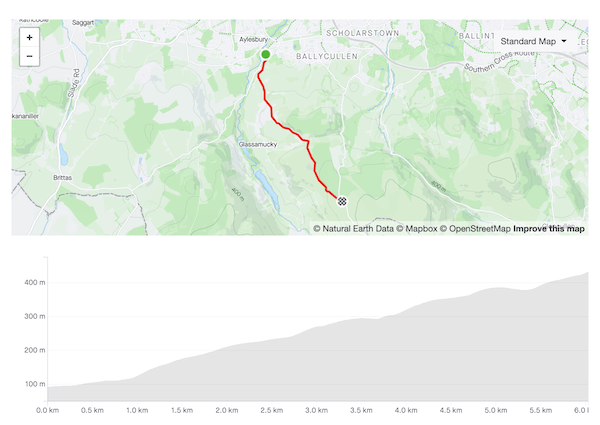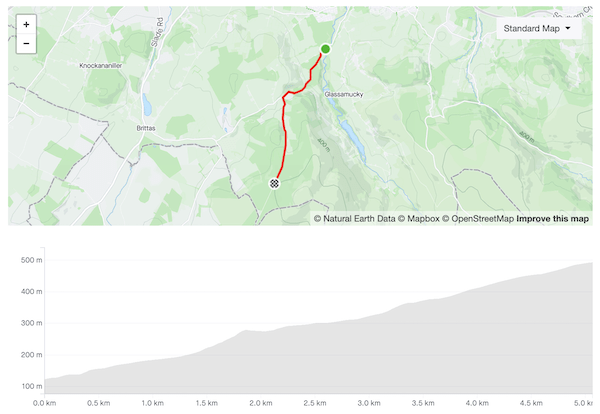
The Firing Range (5.1km, 375m, 7.3%)

Map and Elevation Profile of the Firing Range climb

Strava

The climb to the Firing Range at Kilbride army camp is my favourite training climb, five kilometres sustained effort, much of it along a quiet, well-paved road. Although it’s a fraction of the length of the marquee climbs in the Alps, the gradients and smooth asphalt are comparable.

The first couple of kilometers follow the Ballinascorney climb. Near the summit, bear left onto the slip road (signposted for the Lodge, L7462) and stay left past the Famine Cross. The road levels out for a few hundred meters, then ramps up after a small bridge, briefly hitting double-digit gradients before settling at 8–9%. As the trees give way to open land on the left, the gradient eases and you can gear up for the short ramp to the top.

The road is narrow enough at points that cars will struggle to pass, but it’s little used and during the week you can expect to have it entirely to yourself. Settle into the climb and enjoy the ambient soundtrack provided by streams, insects, birds and sheep, and maybe the odd burst of gunfire.
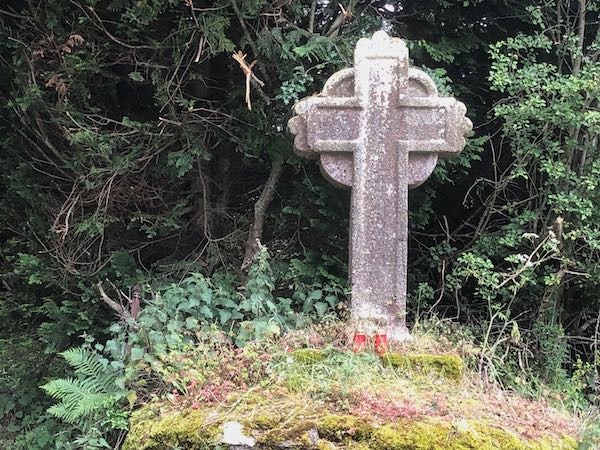
Stone cross on a grassy knoll, commemorating the dead of the Great Famine
The Famine Cross

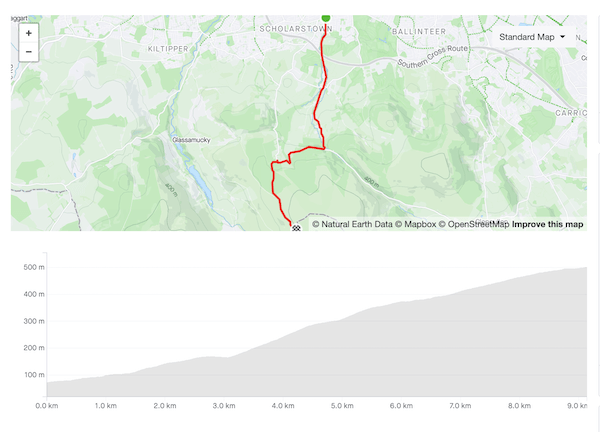
Edmondstown Road (9.1km, 432m, 4.7%)

Map and elevation profile of Edmondstown Road climb

Strava

Edmondstown Road and Stocking Lane are the fraternal twins of the Dublin Mountains, two climbs connecting the same two points, recognisably related but each with its own distinct character. Of the two, Edmondstown Road is the longer and gentler, and the option I prefer at the start of longer rides — the steep ramp on Stocking Lane can deaden the legs if you’re out of shape. But they’re both terrific, and you can substitute them as the moment takes you on any route heading out along the Military Road.

The climb proceeds upwards in steps—an initial gentle rise to Edmondstown golf club flattens to pass under the M50, then becomes steeper as you pass the Merry Ploughboy. There’s another respite section after the turn-off for Mount Venus Road, dropping down a few metres to the longest ramp: 1.4km varying between 8–11%. The road winds left and right under the trees until you shank left over a small bridge, then right past the turn-off for Glencullen.

The gradient eases off, but the road surface deteriorates, the council having taken a distinctly (perversely, one might say) piecemeal approach to repaving the road. Passing the entrance to Cruagh Woods, you say goodbye to double-digit gradients, then make a couple of hairpins to arrive at the Viewing Point.

If this is your very first time there, it is acceptable to join the crowds taking selfies with the city in the background. Otherwise, take the sharp left onto Military Road and keep going. The last 2.5km ease gradually from 7% down to 2% as you approach the Noel Lemass memorial, but the road is well-surfaced to the county line, and you’ll be held back more by the wind which will hit you as soon as you emerge from the trees.

The descent is just as enjoyable as the climb, straight and  blazing fast in parts, technical in others. Keep your wits about you as pass the Cruagh Woods car park—particularly on weekends and holidays, you’ll often encounter drivers engaged in emergency manoeuvres, and stray dogs or children.

The view from Cruagh Road: green fields dropping away under partly cloudy skies, Dublin city and bay visible in the background.
The view from Cruagh Road

Piperstown Road (6km, 351m, 5.6%)

Map and Elevation Profile of Piperstown Road climb

Strava

Piperstown Road is one of my favourite local climbs. Once you’re past Bohernabreena village, the road is very quiet — to see more than a couple of cars along the way up would be unusual. The gradients vary constantly with the steepest ramps hitting 15 and 16%, but the road surface on the upper stretches is billiard table–smooth and you’ll feel like you have an extra couple of gears.

The road starts to rise as soon as you turn off the R114 onto Bohernabreena Road but the fun doesn’t really begin until you pass the church on the right side of the road — a short ramp touching 15%, just to wake you up. The houses lining the side of the road thin quickly as you head up, giving views of the valley to the left.

At 3.5km the road descends briefly, then shanks left and right over a small stone bridge to deliver you straight into the next steep section. You’d like to be able to carry pace into it, but the kink in the road is tight enough to make that difficult. From the bridge on, you’re into the mountains proper, open bogland to your right, pine plantations on the left, and the scars left by a dozen burnt-out cars along the roadway.

Another short drop brings you to the final grind to the top, the junction with Military Road. From there, turn right to continue towards Sally Gap, turn left to drop back down into the city.

Piperstown also makes a very nice descent but during the winter it’s so lightly trafficked that there is often a sheen of moss on the surface of the road that can be treacherous if it’s wet (and it will be). Approach with caution.

Piperstown Road snaking its way up a bleak hillside
Piperstown Road: the final section up to Military Road