
“The deathhauntedness of the Irish brethren was frequently a complication in the working life of Sheriff Stephen Devane. Soaked in an ambience of death from the cradle, they believed themselves generally to be on the way out, and sooner rather than later, and thus could be inclined to put aside the niceties of the living realm. Terrible people, born of a terrible nation.”
— Kevin Barry, The Heart in Winter
Category: Books
Les choses sont contre nous
“All Sankey’s things—the chipped Baby Belling on the draining board; the bits of unmatched blue and fawn carpet; the one-bar fire, the transistor radio, the stereo with its handful of dog-eared albums from the early Seventies—had a used but uncooperative look. He had assembled them, and while he was still alive his personality had held them together; now they were distancing themselves from one another again like objects in a second-hand shop.”
—Climbers, M. John Harrison
Plus ça change…
“Perhaps they are right to camouflage their cafes and restaurants under foreign disguises, because when these places are unequivocally English such a squalid desperation reigns in them as to make anyone who enters think of suicide.”
—Natalia Ginzburg
“England: Eulogy and Lament”, The Little Virtues
Abdicating Responsibility
 In 2018 I moved back to Dublin after four years marooned in New Jersey. I made a practice of reading the weekend edition of the Irish Times from cover to cover, to get a sense of the public psyche of the country (or at least that of the bourgeois strata of the south Dublin suburbs that spawned me). After several few months I gave it up, fearful that prolonged exposure to Pat Leahy might lead to irreversible brain damage. Often it was the obituary page that gave the most interesting view of the state of the nation.
Throughout that year, Rob Doyle had a column in the Culture section, revisiting some of his favourite books. In that determinedly middlebrow milieu, his invocations of Nathalie Sarraute and E M Cioran offered a revivifying dash of vinegar and pretension. A couple of years later, Swift Books published the full set under the title Autobibliography, buttressing each one with rambling author’s notes that often ran ten or twenty times the length of the original entry. In all honesty, it’s thin stuff — the original reviews are too brief to merit the elaboration — but the list is the thing.
There is a certain release in abdicating responsibility in the face of overwhelming choice. There are more books in any shop than I could hope to read in the years that are left to me (hell, there are more books already in this house than I could hope to read etc.) Why prefer one book over the next? How to choose between incommensurable goods? Submit to the dictates of some arbitrary authority: the recommendations of n+1’s annual Bookmatch fundraiser; Anthony Burgess’s 99 Novels; the inexplicable selections of the other people in your book club. I filleted Autobibliography for anything that raised a flicker of interest, discarding half the list to leave sixteen titles I wanted to read and another dozen I would reread.
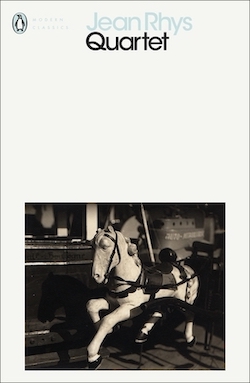
Thus, I read Quartet, the first novel by Jean Rhys. Prior to this Jean Rhys had a shadowy existence in the lumber room of my mind, where undigested and often contradictory scraps of information gather dust, undisturbed by the intrusions of reality. I knew that Rhys had returned from years of obscurity with Wide Sargasso Sea because Diana Athill devotes a chapter to the story in Stet, but no image had formed of the earlier career to which this constituted a comeback. For that matter, I had not read Wide Sargasso Sea, on the doubtless specious grounds that I had never read Jane Eyre either.
“The room was full of men in caps who bawled intimacies at each other; a gramophone played without ceasing; a beautiful white dog under the counter, which everyone called Zaza and threw bones to, barked madly”.
This, on page 4. Rhys’s prose is littered with these lightly paradoxical phrases (“bawled intimacies”) that nonetheless encapsulate perfectly some detail of life, the amicable bedlam of a busy Parisian cafe. Her spare, economical style might read too quickly were it not for these arresting turns of phrase. Quartet is a short book (Doyle disarmingly admits that many of his choices were driven by exigency — with only seven days to come up with the next instalment, I too might have picked Bolaño’s inscrutable Antwerp over 2666) but it covers a lot of emotional experience. Its portrait of a young woman increasingly unmoored and alone in interwar Paris reminded me in some ways of Play It As It Lays, by Joan Didion (also one of Doyle’s picks).
Penguin Modern Classics recently reissued Rhys’s four early novels (After Leaving Mr. Mackenzie, Voyage in the Dark, and Good Morning, Midnight are the others). Their edition of Quartet is typical of their routine high quality: sharp jacket design incorporating a Lee Miller photograph, clean typography, and a solid contextual essay thoughtfully placed after the text. I’ll read the lot. I might even finally get to Wide Sargasso Sea.
First Love
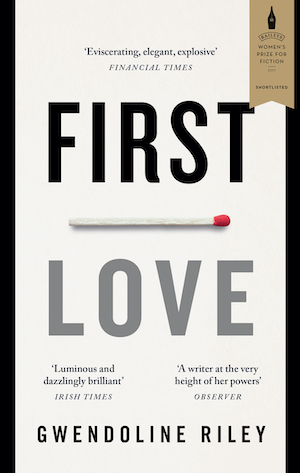 There’s something concentrated, claustrophobic, about Gwendoline Riley’s First Love, such that it comes as a relief that the book is only 167 pages long. The prospect of spending more time in the company of bullying, self-pitying Edwyn feels intolerable, the reader just as trapped as Riley’s protagonist, Neve. The liberal use of italics for emphasis in the dialogue should feel heavy-handed but Riley’s pitch is perfect, capturing the leaden sarcasm and sullen aggression of everyday speech. Her acerbic observation of modern British manners recalls Rachel Cusk’s trilogy, Transit in particular, but with immediacy and intensity in place of Cusk’s glassy distance.
Neve’s relationships with her parents seem to foreshadow those in Riley’s subsequent novel, My Phantoms, as though she realised while writing First Love that there was rich material there that couldn’t be explored thoroughly without losing the essential focus on the central relationship between Neve and Edwyn, unbalancing a very tight novel. Which is not to say that Riley repeats herself — the shift in focus develops the father beyond the thumbnail sketch in First Love, and if Neve’s mother is memorable, Hen in My Phantoms is indelible, one of the great comic monsters of recent years, needy, self-regarding, oblivious. What unites Riley’s characters is their uncertainty about what is normal, what one can reasonably expect of other people, or of life. It feels a very modern anxiety.
 Hors Catégorie