
64 Quartets is already nine posts deep into the ninth quartet of his sixty-four, Wire, presenting an idiosyncratic, discursive lexicon of Wire’s initial run on Harvest. The ninth post only gets us as far as Bowie, David, with further lexicons promised covering Wire’s subsequent incarnations on Mute and under their own aegis, so settle in for the long haul. Hard to imagine any band more deserving of a full-length critical biography, and these posts might be as close as we’re getting. Start here.
Author: Eoghan
Randonneur, penseur, bon viveur
Repetition in the Music, We’re Never Going to Lose It
A couple of decades ago, I found myself in the same boat as Internal Exile, struggling to cope with the dizzying abundance of music in the digital age, finding that the music meant less and less to me as I bought more and more, sprinting towards an endlessly receding horizon. I bought records and CDs so voraciously that I barely had time to listen to them once, just enough to check that they played all right, before I was back out the door to buy more. To this day, I remember very little about the music of that time. Song titles, album covers conjure nothing, no lingering frisson or echo in the memory.
Rather than surrender to the flow, I forced myself to slow down, to try to listen to records until they etched an outline in my memory. It’s been a long process, gradually weaning myself off that impulse to consume, embracing repetition in the hope of re-enchantment. That enchantment remains elusive—I’ll never regain that teenage obsession that led me spend entire mornings in bed, flipping a C90 cassette of Aqualung and Morrison Hotel over and over. My relationship to music now is more like an addict in recovery, a little burned-out and constantly self-monitoring for fear of relapse. I wiped the music library on my computer in 2015 and started over; in the decade since, there are only a half-dozen albums that I’ve listened to more than ten times.
But even that limited repetition is enough to enrich the music, to give me the time to dwell in the grain of the sound, to build some personal context around the music. Sound is voluptuous, but context is meaning. Everything I thought and felt while listening to an album, whatever I read or heard that led me to it in the first place, the conversations about it with friends, all that accretes meaning around the music like nacre around a nascent pearl.
Seeing the music performed live only becomes more important as the years go by, vivid nights in dank clubs, reeling from the volume, the intoxication of the crowd, the unflagging magic of hearing this music at the moment of (re)creation. The debriefing session in the pub afterwards, the lingering reverberation of the experience in the days after. Listening to the recordings again, reconfiguring their meaning in light of the performance.
So the notion of gluing a record to your turntable resonates strongly, even if it’s as bathetic a choice as Underwater Moonlight. Listen to it until you know it inside-out, like it’s the only record you own, the only record ever made. For all I said that I don’t remember much of the early 2000s, I recognised the jacket image at the top of Rob’s post immediately, remember where I bought that double-disc reissue on Matador, can hum a few bars of “I Wanna Destroy You” and “Old Pervert”. However little that is, it still means something to me.
The Body You Deserve
I came to HTRK through the back door, after reading a glowing review of Rhinestones in the Wire. Knowing no better, I missed completely the shock and surprise of hearing a band characterised by the blunt thump of a Roland drum machine and cavernous bass throb sidestep into fingers brushing nylon guitar strings and hushed 5am vocals. Only after seeing their low-key but dazzling set at the Workman’s Club did I start working through their back catalogue: the minimalist noise rock of their Rowland S. Howard–produced debut, Marry Me Tonight, the dubbed electronics of Psychic 9-5 Club.
There aren’t many revelations in this Quietus interview with Jonnine Standish and Nigel Yang, but the tracks selected are a great introduction to their music. Luke Turner nails most of my favourites (“Gilbert and George”, “Fascinator”) but from Psychic 9-5 Club, I’d give the nod to the album closer:
(Something about that “Strange World of…” series title feels lumpen and hapless to me…could there be anything less strange than the doggedly unglamorous work ethic of Fugazi, for instance?)
“Everyone can draw on myth to sublimate their own modest experiences: betrayed by a woman he loves, one man calls her a slut; another is obsessed by his own virile impotence: this woman is a praying mantis; yet another takes pleasure in his wife’s company: here we have Harmony, Repose, Mother Earth. The taste for eternity at bargain prices and for a handy, pocket-sized absolute, seen in most men, is satisfied by myths. The least emotion, a small disagreement, become the reflection of a timeless Idea; this illusion comfortably flatters one’s vanity.”
—Simone de Beauvoir, The Second Sex
Coffeeneuring: the Aftermath of Ashley
There were a couple of fine days in the wake of storm Ashley, and I rode out on Tuesday morning under blue skies. For reasons opaque in retrospect, I decided to take on Cupidstown Hill en route to Naas, crawling up its 18% ramp in a minuscule gear. Barry O’Driscoll used Cupidstown for an Everesting, climbing it 75 times over the course of thirteen hours, which surely earned him a plenary indulgence…my modest single ascent merited nothing more indulgent than an espresso and a flapjack at PS Coffee Roasters. The barista regaled me with his childhood memories of going mountain biking with his dad, but admitted that surfing was his sport these days. Evidently lugging a surfboard to Sligo is more fun than climbing Ticknock on a full suspension mountain bike.
By Thursday the wind was picking up again. Feeling lazy, I took the road south along the Dublin coast to examine Dun Laoghaire-Rathdown’s latest “innovations” in cycling infrastructure. I took the morning cafe stop at Hatch Coffee in Glasthule where they squandered points by checking whether I wanted my espresso “for here”, then handing it to me in a paper cup regardless. I sat outside, watching mourners streaming out of the church across the road, thinking back to my grandmother’s funeral and carrying her coffin from Quinn’s funeral home up the street to that same church.
I grew up in Sandycove: the poles of my book-obsessed childhood were the library at the bottom of York Road in Dun Laoghaire to the north, my grandmother’s bookshop in Bray to the south. The equator was Eamonn’s Bookshop in Sandycove village, which I visited any time I had ten or twenty pence to my name, in the hopes that a hitherto unknown Famous Five or Biggles book might have appeared on its shelves. I was pleased to see that it still endures, and Eamonn himself too, if the white-haired gentleman sitting at the front of the shop was he.
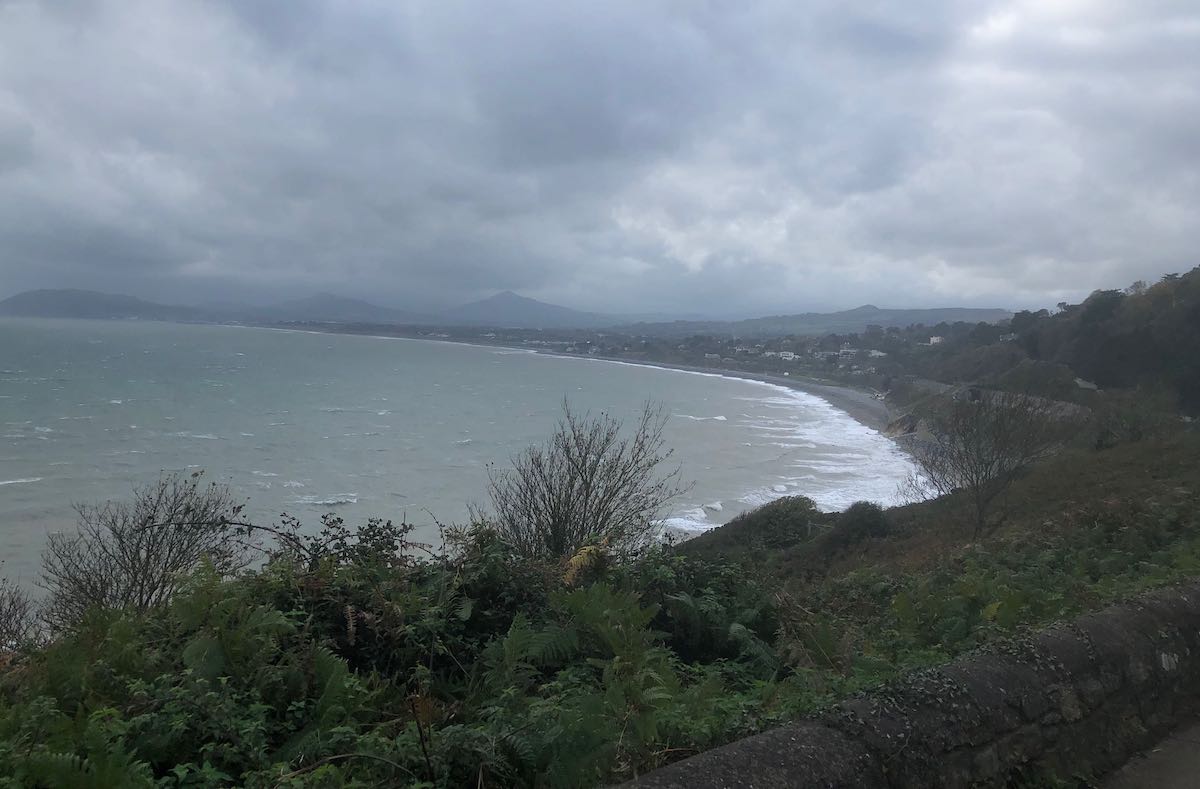
Despite the bookish tone of my reminiscences, I bypassed the Martello tower that was home to Buck Mulligan and Stephen Daedalus in favour of a straight run through Dalkey and up the Vico Road to Killiney, the vaunted resemblance to the Bay of Naples diminished by the grey skies and choppy water. The wind was at my back as I cut inland to Kilternan and Tibradden before dropping back down into the city.
Coffeeneuring: Strawberry Beds and Self-Deception

With the hour changing next weekend, it’s time to put the good bike away for the winter — dry roads are already a distant memory, and every ride leaves a rime of grit and leaf mould on the drivetrain. Last Sunday I pulled the fixed-gear out of the shed, chipped away the thick crust of agricultural filth remaining from the spring, and drenched the chain in thick, green lubricant.
The following day I took it for a shake-out ride along the Strawberry Beds. Hugging the north bank of the Liffey, it’s a beautiful stretch of road, the slow-moving river glinting in the sunshine. Nonetheless, I rarely ride it because, in a remarkable feat of road engineering, the council have managed to squeeze no fewer than twenty-six speed bumps into a distance of 2.5km, with another four as an amuse-bouche when you join the road at the Knockmarroon Hill. The velvet smoothness of the tarmac in between them comes more as a taunt than a relief.
Gingerly checking that I still had all my teeth, I stopped into Coffee Works in Lucan village. It was fairly thrumming with activity on a Monday morning, the tables inside and out filled with people deep in conversation. Points awarded for checking whether I wanted the espresso in a ceramic cup (yes, always yes…espresso in a paper cup is an offence in the eyes of God) and giving me a glass of water to accompany it. The roast (courtesy of Groundwork from Celbridge) was a bit dark for my taste, but their hearts are clearly in the right place and I finished the rest of the ride with a song in my heart.
I suspect many Dubliners are unaware of quite how much the city is sheltered from rain and wind by the arc of mountains to the south-west. But every cyclist knows that no matter how sunny and still it may be when you leave your house, thirty minutes later you can be battling through sideways rain against a malevolent wind bent on your destruction. If you can feel the breeze down in the city, it’ll be a gale up at Sally Gap.
Thus it was with some trepidation that I watched the wind merrily tossing the leaves around the back garden as I ate my breakfast on Thursday morning. I headed up Stocking Lane more in hope than expectation, the calm in the lee of the hill offering fertile ground for self-deception. But there was no hiding from the truth when I got to the Featherbeds, unpredictable gusts aggressively shoving the handlebars left and right. I staged a tactical retreat down the Glencree valley.
There was a long line at the Bear Paw in Enniskerry (more power to them) so I pushed on to Mugg Uggly. Tucked away behind Glencairn LUAS stop, Mugg Uggly is an oasis of conviviality in a desert of blank suburban roads and newbuild apartment blocks. Screened by trees and high walls, you could imagine yourself far outside the city, the roar of the traffic a muted and distant. The espresso was good enough that I can overlook (if not entirely forgive) the paper cup and the terrible name. While these autumn days stay mild enough to sit outside, it’s hard to imagine a better place to stop.
Weirdo Ceol and Age Wars
Bandcamp Daily on “weirdo ceol.” It’s indicative of some kind of cultural cringe that the only artist mentioned in the article I’m familiar with is the one who is not from Ireland.
M. John Harrison knows that sometimes we just want to hear the hits.
Coffeeneuring: A Dreadful Litany
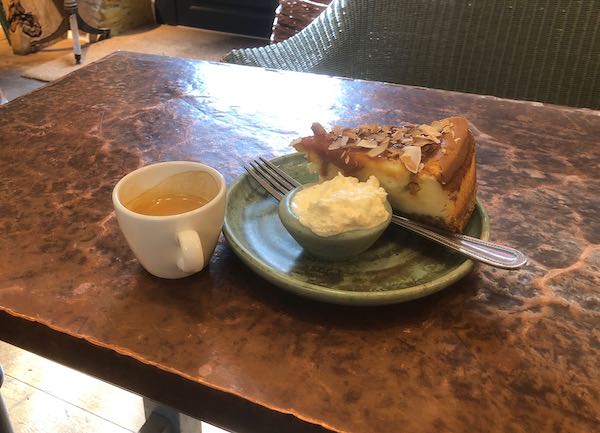
Proverbially, a journey of a thousand miles begins with a single step. But a journey of a mere sixty kilometres starts with a double espresso. It’s important to set a baseline for quality when embarking on a research project as rigorous as the 2024 Coffeeneuring Challenge, and Five Points is always my point of departure.
My lab assistant for the first ride was Rider’s Bloc. In recent years the block has become systemic, and he gets out on the bike only marginally more often than he posts on his blog, so we took it pretty easy on the way out to Blessington. Befitting two men in their middle years, 90% of the conversation went along these lines:
— do you know so-and-so?
— I don’t think so
— right. Well, she has cancer
and so on in a dreadful litany of terminal diagnoses, and distant acquaintances who woke up one morning dead as a doornail. “Sniper alley,” he commented sagely, “that’s where we are.” Only the offer of some cholesterol- and carcinogen-laden cake could prise him away from the subject of mortality and our precarious purchase on life.
We pulled into an unprepossessing driveway, signposted Brew 21. I was half-expecting yet another coffee truck, but no, past some picnic tables arrayed on an astroturf lawn I found the entrance to a sizeable cafe. The bar is straight out of the 3FE playbook: Victoria Arduino espresso machine, Puq Press automatic tamper etc. Decent espresso, but one star deducted for serving it in a paper cup. And the astroturf. We returned to the city warmed by the rare October sun.
I was solo on the second ride this week, a return visit to Roundwood Stores. Again the sun was out, but in the two days intervening the temperature had dropped by ten degrees and it was barely above freezing when I left Harold’s Cross. The reason for this became apparent when I left the warmth and bourgeois comfort of the cafe to head home, and spent the next two hours battling into a biting northerly. The brisk pace I set on the way to Roundwood should have tipped me off, but the delusional part of your brain always wants to think it’s that you have good legs, that you’re in great shape. Never that the wind might be behind you, waiting to sandbag you as soon as you change direction.
In the year since I first went there, Roundwood Stores has come to exercise a magnetic pull, dragging me in any time I pass within five kilometers of it. The coffee can be hit-or-miss, but the soups are invariably excellent, and the only thing that puts me off the rest of the menu is the massive portions…the drags over Ballinastoe and Djouce are all the more grinding after eating a slab of focaccia the size of your head.
Be Mine Tonight
Chasing Mailboxes announces the 14th annual Coffeeneuring Challenge. Last year I failed ignominiously after disappearing off to Le Guess Who with only five rides in the bag, and coming home too hungover to contemplate getting on the bike to finish it off. This year I will brook no failure.
Dean Roberts died a few months ago, far too young. He never seemed to receive the attention that his music deserved, despite releases on labels as storied as Mille Plateaux, Kranky, and Erstwhile. He probably tired of the comparisons with Mark Hollis and Talk Talk, but I can think of few artists who could bear the comparison so well, whose music matched that taut-nerved tension and haunted beauty.
And the Black Moths Play the Grand Cinema by Dean Roberts
Philip Sherburne’s comprehensive retrospective at Futurism Restated has disappeared behind the paywall, but Tone Glow and the Wire have reposted old interviews.
Drinking the Cole-Aid
After several years of intense focus on Go, studying, reviewing games, playing almost daily, I’m burned out. I barely play any more, and I expect the upcoming European Go Congress in Toulouse to be my last tournament for the foreseeable. I’m extricating myself from the affairs of the Association, winding down as tournament director.
In compensation, I’ve developed a raging thirst for other boardgames. After several years of intense focus on the classical, highly abstract, literally black-and-white world of Go, emerging into the densely crowded, richly varied ecosystem of modern boardgames feels almost hallucinatory. Despite the rival attraction of videogames, boardgames continue to sustain a community large enough to support development of complex, demanding, richly involving games.
In particular, I’m fascinated by the work of designer Cole Wehrle. Perhaps because his background is in wargaming rather than the eurogames I usually play, his games feel very fresh to me, a whole new world to explore. On the one hand, his work for Leder Games (Root, Oath, ARCS) conceals surprisingly vicious fantasy/SF conflict beneath the wonderful artwork of Kyle Ferrin (comparable to the most flamboyant of Bill Watterson’s Sunday pages for Calvin & Hobbes). On the other, the games from the company Cole runs with brother Drew, Wehrlegig (Pax Pamir, John Company), are alive with historical flavour and detail.
If I were to pick one, it would be John Company, in which players take the part of families jockeying for position within the East India Company, negotiating and scheming for prestige while the Company pillages India. It has the sense of historical sweep and development of the legendary (but unplayable) Republic of Rome, compressed into something you can finish in an afternoon. The gameplay is multilayered, offering several avenues to explore en route to the Company’s nigh inevitable collapse amid the corruption and self-interest of those who run it. The implicit critique of the imperialist project is underscored by the artwork, which draws heavily on period caricaturists such as Cruikshank and Gillray.
It doesn’t hurt that Cole is deeply embedded in the community, publishing extensive design diaries for each of his games on BoardGameGeek, actively participating in discussion and responding to questions online. His academic grounding in literature studies perhaps accounts for his interest in narrative and the stories players tell through the games they play, his games explicitly providing the hooks on which stories can hang without imposing a set storyline. And he’s not embarrassed to slip into theory mode, once memorably describing Root (a Game of Woodland Might and Right) as an exploration of Foucauldian biopolitics…which maybe it is, as depicted by Walt Kelly.
His current project is Molly House, in which players will “throw grand masquerades and cruise back alleys as a gender-defying molly in early eighteenth century London.” I foresee a few problems getting that one to the table, but I backed it anyway…it’ll be worth it just to see where he goes next.
 Hors Catégorie